Wine regions in Latium 41 growing regions
Description to Latium
The region (Italian: Lazio) with the capital Rome is located in the centre of Italy at the "knee" of the boot. It stretches for 320 kilometres in the west along the coast of the Tyrrhenian Sea. All of the other six central regions border on Lazio. Starting from the north, these are Tuscany, Umbria, Marche (only a short stretch), Abruzzo, Molise and Campania. Even in ancient times, there was extensive viticulture and a distinctive wine culture here. The region provided food and drink for the capital of the Roman Empire. In ancient times, full-bodied, amber-coloured, spicy white wines came from here.
For many centuries, Rome's poets praised the wines of Lazio, especially the predecessor of Frascati. Wine played an important role at the nearby papal court in the Middle Ages. Pope Paul III (1468-1549) outlawed French wine and had his wine steward Sante Lancerio draw up an overview of the Italian wines of the time. In 2021, two hectares of vines were planted in the papal gardens of the Castel Gandolfo summer residence on the shores of Lake Albano. The resulting wine is used exclusively for the Vatican's own purposes, for example as Mass wine.
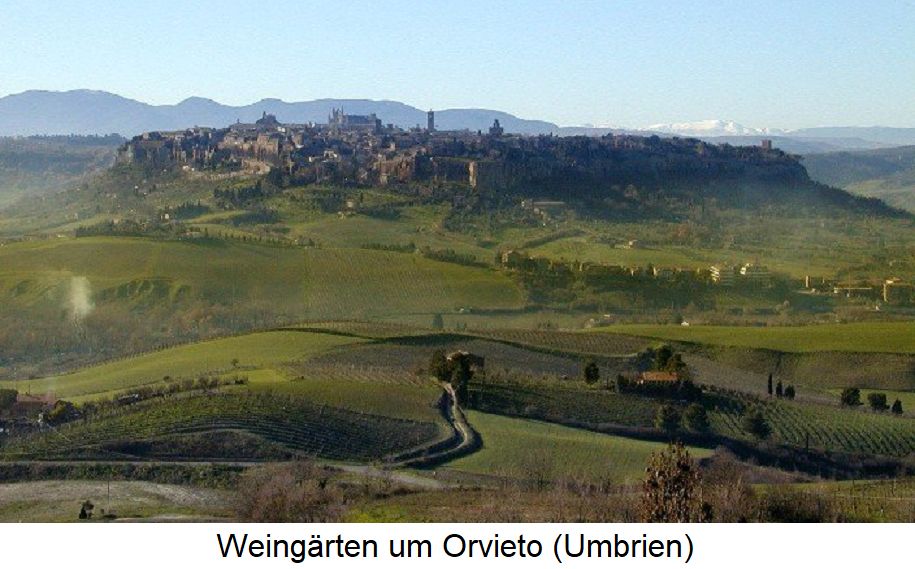
The vineyards cover around 20,500 hectares of vines. The climate is dry and hot on the coast and becomes increasingly cooler and wetter inland. Vines are cultivated almost everywhere except in the Apennines with Monte Terminillo, the highest peak at 2,216 metres. White wines, which thrive particularly well on the often volcanic soils, are produced to 80%. It is worth noting that there are also extensive vineyards within the administrative boundaries of the city of Rome. Over a third of wine production is carried out by winegrowers' co-operatives. The numerous small winegrowers cultivate an average of only half a hectare of vineyards and supply their grapes to these large wineries.
The most important white wine varieties are Bellone (Cacchione, Uva di Spagna), Bombino Bianco (Bonvino), Chardonnay, Grechetto Bianco (Grechetto di Orvieto), Greco, Greco Bianco, Malvasia Bianca di Candia (Malvasia Rossa), Malvasia Bianca Lunga, Malvasia del Lazio (Malvasia Puntinata), Moscato Bianco (Muscat Blanc), Pinot Bianco (Pinot Blanc), Pinot Grigio (Pinot Gris), Procanico (variety of Trebbiano Toscano), Rossetto, Sémillon, Trebbiano Toscano, Trebbiano Giallo and Trebbiano Verde (Verdicchio Bianco). Varieties of the Malvasia and Trebbiano variety groups are used in many white wines.
The most important red wine varieties are Aleatico, Bombino Nero, Cabernet Franc, Cabernet Sauvignon, Canaiolo (Canaiolo Nero), Cesanese (with the two varieties Cesanese di Affile and Cesanese Comune), Ciliegiolo, Grechetto (Grechetto Rosso), Merlot, Montepulciano (Violone), Nero Buono di Cori, Pinot Nero (Pinot Noir), Sangiovese and Syrah. The IGT areas(regional wines) as well as the DOC and DOCG areas(quality wines) in the Lazio region are:
- Aleatico di Gradoli (DOC)
- Anagni (IGT)
- Aprilia (DOC)
- Atina (DOC)
- Bianco Capena (DOC)
- Cannelino di Frascati (DOCG)
- Castelli Romani (DOC)
- Cerveteri (DOC)
- Cesanese del Piglio or Piglio (DOCG)
- Cesanese di Affile or Affile (DOC)
- Cesanese di Olevano Romano or Olevano Romano (DOC)
- Circeo (DOC)
- Civitella d'Agliano (IGT)
- Colli Albani (DOC)
- Colli Cimini (IGT)
- Colli della Sabina (DOC)
- Colli Etruschi Viterbesi or Tuscia (DOC)
- Colli Lanuvini (DOC)
- Cori (DOC)
- Costa Etrusco Romana (IGT)
- Est! Est!!! Est!!! di Montefiascone (DOC)
- Frascati (DOC)
- Frascati Superiore (DOCG)
- Frusinate or del Frusinate (IGT)
- Genazzano (DOC)
- Lazio (IGT)
- Marino (DOC)
- Montecompatri-Colonna or Montecompatri or Colonna (DOC)
- Moscato di Terracina or Terracina (DOC)
- Nettuno (DOC)
- Orvieto - also Umbria (DOC)
- Roma (DOC)
- Tarquinia (DOC)
- Velletri (DOC)
- Vignanello (DOC)
- Zagarolo (DOC)
Image: By Adriano - Own work, CC BY-SA 3.0, Link
Classified wine producers in Latium 8


find+buy for Latium 31




Recent wines 292
 Castel de Paolis
— Latium
2021 Lazio IGT Bianco "Donna Adriana"
Up to 17.00 €
Castel de Paolis
— Latium
2021 Lazio IGT Bianco "Donna Adriana"
Up to 17.00 €

 Ômina Romana
— Latium
2022 Lazio IGT Merlot Rosato
87 WP
very good
22.50 €
Ômina Romana
— Latium
2022 Lazio IGT Merlot Rosato
87 WP
very good
22.50 €
 Ômina Romana
— Latium
2020 Lazio IGT Viognier "Ars Magna"
89 WP
very good
69.00 €
Ômina Romana
— Latium
2020 Lazio IGT Viognier "Ars Magna"
89 WP
very good
69.00 €
 Ômina Romana
— Latium
2019 Lazio IGT Viognier "Ars Magna"
90 WP
excellent
69.00 €
Ômina Romana
— Latium
2019 Lazio IGT Viognier "Ars Magna"
90 WP
excellent
69.00 €
The most important grape varieties
More information in the magazine
- How Sicily is reinventing itself An island and the future of wine
- Nebbiolo in all its facets Northern Piedmont and Roero
- Giannitessari Collection of the year 2023/2024 - Veneto
- Salvioni - La Cerbaiola Collection of the year 2023/2024 - Tuscany
- Schreckbichl Winery - Cantina Colterenzio Collection of the year 2023/2024 - South Tyrol
- E.Pira & Figli - Chiara Boschis Collection of the year 2023/2024 - Piedmont
- Denavolo Collection of the year 2023/2024 - Emilia Romagna
- The collections and discoveries of the year Tasting season 2023/2024
- Time of change Wine country South Tyrol
- Paradisiacal times! Tasting: European sparkling wines for the festive season