| Chablis AOC |
Description to Chablis AOC
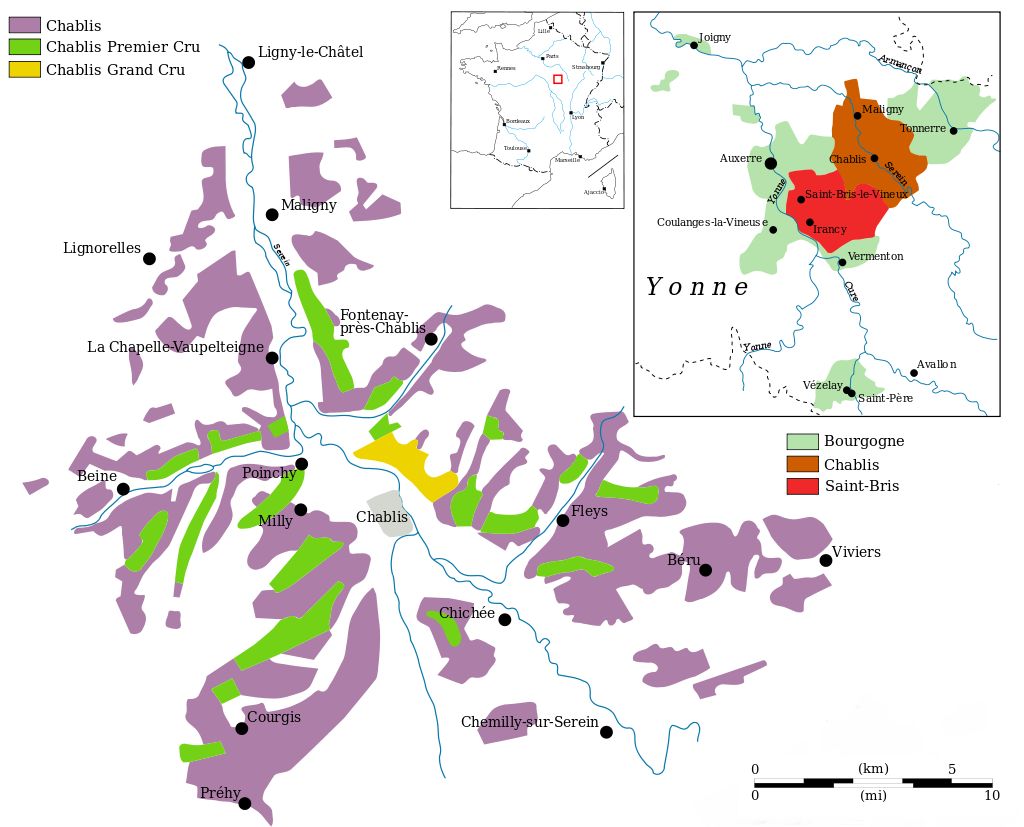
The appellation, named after the town of the same name and classified in 1938, is located to the north and delimited from the Burgundy wine region in what is known as Basse-Bourgogne in the Yonne department. To the southwest of it lies the Saint-Bris area, which was included before the appellation regulation. Chablis is separated from the Côte d'Or by the Morvan mountains and is much closer to Champagne than the other Burgundian areas. The Romans were already cultivating vines here in the 2nd century and later the monastic orders of the church took over the cultivation. The Cistercian Abbey of Pont igny, whose monks are said to have introduced the Chardonnay here, earned particular merit. At one time, this was the largest wine-growing area in France, with 40,000 hectares surrounding the town of Auxerre. Sales difficulties and damage caused by phylloxera led to a switch to other agricultural products.
In addition, the area was and is extremely vulnerable to hail and frost until May, which is why entire harvests were destroyed time and again. All this contributed to the fact that by the mid-1950s only 500 hectares were under cultivation. From the beginning of the 1960s, attempts were made to successfully combat the danger of frost with various measures. Very effective is the installation of oil-fired ovens in the vine rows, the heat of which is distributed in the vineyard with windmills. In addition, the vines are sprayed with water, whereupon the resulting ice film forms a protective cover around the young shoots. Today, there are again around 4,500 hectares of vines in Chablis and another 19 communes.
The pale yellow wine with a greenish sheen is made from the pure Chardonnay grape variety (here called Beaunoise) and is vinified dry. It has a typical mineral aroma of flint (French: "goût de pierre à fusil") and tastes mild and fruity despite its strong acidity, which is due to the predominant clay and limestone soil. Traditionally, the wine is matured in concrete cisterns or in stainless steel tanks with subsequent transfer to traditional large oak barrels, but there are also many producers who prefer ageing in barriques. Most wines today undergo malolactic fermentation. A top Chablis wine has enormous ageing potential of up to several decades.
Four-level quality hierarchy
The quality hierarchy corresponds to the four-level system of Burgundy classification (as opposed to Bordeaux) that applies throughout the region. In addition to the Chablis appellations of origin, winemakers are free to market their wines under Burgundy's regional appellations. Other grape varieties are also permitted for this purpose.
Chablis Grand Cru
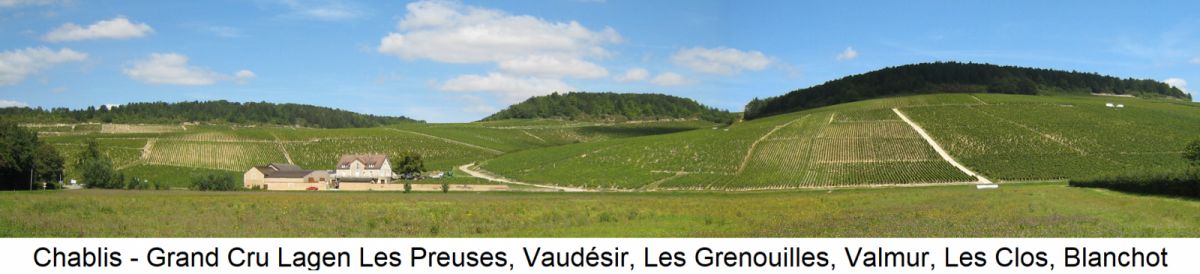
This top appellation covers around 100 hectares in seven top sites on a south-facing slope north of the town of Chablis. These are Blanchot (12 ha), considered the best, as well as Bougros (12 ha), Grenouilles, Les Clos (27 ha), Les Preuses (11 ha), Valmur (13 ha) and Vaudésir (14 ha). Another vineyard called La Moutonne is not listed as Grand Cru, but is allowed to display the designation on the label because 2.3 hectares of it are located in the two sites Vaudésir and Les Preuses. The yield limit is a maximum of 45 hl/ha. The wines account for only 5% of Chablis production.
Premier Cru
These wines may either bear the name of one of the 40 individual vineyards or the name of a so-called vineyard group on the label. The latter is predominantly used, these are (in brackets the vineyards that are allowed to use the collective term): Côte de Jouan, Côte de Léchet, Côte de Vaubarousse, Beuaroy (Troesmes, Côte de Savant), Berdiot, Chaume de Talvat, Fourchame (Côte de Fontenay, L'Homme Mort, Vaulorent, Vaupulent), Les Fourneaux (Côte des Prés-Girots, Morein), Les Beauregard (Côte de Cuissy), Les Landes et Verjuts, Mont de Milieu, Montée de Tonnere (Chapelot, Côte de Bréchain, Pied d'Aloup), Montmains (Butteaux, Forets), Vaillons (Beugnons, Chatains, Les Epinottes, Les Lys, Mélinots, Roncières, Sécher), Vaucoupin, Vau de Vey (Vaux Ragons, Vau Ligneau and Vosgros (Vaugiraut). The yield limit is 50 hl/ha. The total area is 750 hectares in 15 communes (not the commune of Chablis itself) and provides about 30% of the production.
Chablis
This appellation covers a very large area with around 2,300 hectares of vines. No vineyard may be mentioned on the label. The yield limit here is also 50 hl/ha. These wines account for about 60% of the production. In good vintages, this can be an excellent, classic Chablis.
Petit Chablis
This appellation covers 1,800 hectares of vineyards in the poorer soils and sites around Chablis, but only a small proportion of these are used. The yield limit is also 50 hl/ha. There are efforts to change the somewhat trivialising name or to abandon this class altogether.
Producers
Well-known producers with Grand Cru and/or Premier Cru sites in the Chablis appellation include Barat, Bichot (Domaine Long-Depaquit), Billaud-Simon, Pascal Bouchard, La Chablisienne, Michel Cobois, Jean Collet, Jean Dauvissat, René & Vincent Dauvissat, Jean Defaix, Jean-Paul Droin, Joseph Drouhin, Gérard Duplessis, Domaine Marcel Duplessis, William Fèvre Domaine de la Maladière, Château Grenouilles, Jean-Pierre Grossot, Michel Laroche, Domaine des Malandes, Domaine des Maronniers, Domaine de Meulière, J. Moreau & Fils (Boisset), Sylvain Mosnier, Gilbert Picq, Domaine Pinson, Jean-Marie Ravenau, Guy Robin, Philippe Testut, Jean-Marie Raveneau, Château de Viviers, Robert Vocoret & Fils and Domaine Vocret.
Grand Cru sites: By CocktailSteward - Own work, CC BY 3.0, Link
Map: By DalGobboM¿!i? - Own work, GFDL, Link
Recent wines 30

 Château de Béru
— Burgundy
2018 Chablis AOC Clos Béru
Alice & Olivier de Moor
— Burgundy
2020 Chablis AOC Bel-Air et Clardy
Up to 50.00 €
Domaine Joseph Drouhin
— Burgundy
2016 Chablis AOC Drouhin-Vaudon
Up to 20.00 €
Château de Béru
— Burgundy
2018 Chablis AOC Clos Béru
Alice & Olivier de Moor
— Burgundy
2020 Chablis AOC Bel-Air et Clardy
Up to 50.00 €
Domaine Joseph Drouhin
— Burgundy
2016 Chablis AOC Drouhin-Vaudon
Up to 20.00 €
The most important grape varieties
More information in the magazine
- Liv-ex Power 100: Burgundy The fastest expanding region in the secondary market
- Domaine Germain Château de Chorey-les-Beaune 1995, AOC Chorey-les-Beaune, Burgundy, France
- Domaine Pierre Brazey, France Pommard 2005, Dézize les Maranges, Burgundy
- A guest in Burgundy Wine tasting of the Domaine Joseph Drouhin
- Côte Chalonnaise Burgundy without airs and graces
- An old Burgundy And the question: What is a wine experience?
- Assmannshäuser Höllenberg meets Burgundy Point victory for David
- Two people and one wine Burgundy
- Grüezi to all The lot 1208. Or: What old Burgundies can cost today
- Plaimont - The vine rescuers from south-west France Advertisement