| Alsace AOC |
Description to Alsace AOC
Name of the French wine growing region Alsace. Alsace (or Vin d'Alsace) is also the name of the region's extensive appellation. The other two AOC are Alsace Grand Cru and for the sparkling wines Crémant d'Alsace. These wines account for around 75% of production. Most of them are varietal wines made from 100% of a variety indicated on the label. In the absence of this indication, it is a cuvée of different varieties. The AOC designation consists of Alsace and the following variety or wine type name, for example "Alsace Riesling". The yield is limited to a maximum of 80 hl/h, for Pinot Noir to 75 hl/h.
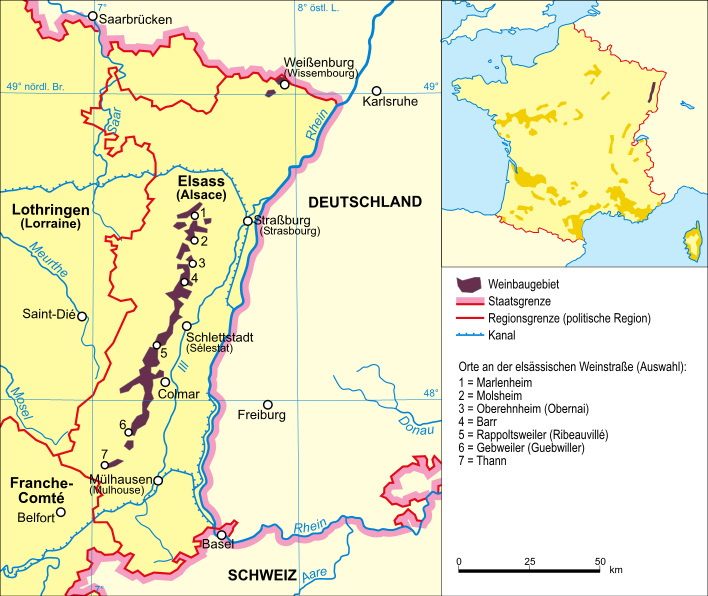
From Domenico-de-ga from the Wikipedia, CC BY-SA 3.0, Link
Auxerrois: The name of this variety does not appear on the label. However, Auxerrois is one of the varieties that can be used together for the AOC "Alsace Pinot Blanc".
Chasselas or Gutedel: There are white and rosé varieties. At the beginning of the 1960s, this variety still accounted for 40% of the total, but today it accounts for only 1%.
Clevner or Klevner: The Pinot Blanc is usually marketed under this name.
Edelzwicker (also Gentil): A cuvée.
Gewurztraminer (Gewürztraminer): This variety occupies about 18% of the vineyard area. The wine may also be aged as "Vendange Tardive"(late harvest) and "Sélection de Grains Nobles" (from noble rotten berries).
Klevener de Heiligenstein: From Savagnin Rose.
Muscat: Of the variety known here as Muscat d'Alsace, Muscat Blanc, white and rosé varieties may be used. The Muscat Ottonel variety is also authorised. The wine may also be aged as "Vendange Tardive" (late harvest) and "Sélection de Grains Nobles" (from noble rotten berries).
Pinot: This does not denote a single grape variety, but Pinot Blanc, Pinot Gris, Pinot Noir (pressed white) and Auxerrois may be used. Mostly the wine is a blend of Pinot Blanc and Auxerrois. These two varieties occupy 21% of the vineyard area. However, there are also pure varieties (except from Pinot Gris). Alternatively, the terms "Clevner" or "Klevner" may be used.
Pinot Gris: The former designation Tokay-Pinot Gris has been prohibited since 1993. This variety occupies 10% of the vineyard area with a constantly increasing tendency. The wine may also be matured as "Vendange Tardive" (late harvest) and "Sélection de Grains Nobles" (from noble rotten berries), subject to strict regulations.
Pinot Noir: This is the only red wine variety authorised, occupying 9% of the vineyard area. In the past, it was mostly vinified as rosé or pressed white as Blanc de noirs. Now it is also increasingly being pressed as a red wine. More and more winegrowers are experimenting with longer maceration, longer ageing in wooden barrels and also in barriques.
Riesling: With 23% of the vineyard area the most common grape variety. The wine may also be aged as "Vendange Tardive" (late harvest) and "Sélection de Grains Nobles" (from noble rotten berries).
Sylvaner (Silvaner): This variety is allowed in the AOC Alsace, but only in a single Crand-Cru vineyard (Zotzenberg).
Recent wines 86
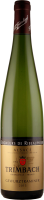 Trimbach F. E.
— Alsace
2015 Alsace AOC Gewürztraminer "Seigneurs de Ribeaupierre"
45.20 €
Trimbach F. E.
— Alsace
2015 Alsace AOC Gewürztraminer "Seigneurs de Ribeaupierre"
45.20 €

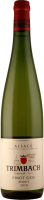 Trimbach F. E.
— Alsace
2018 Alsace AOC Pinot Gris Réserve
24.40 €
Trimbach F. E.
— Alsace
2018 Alsace AOC Pinot Gris Réserve
24.40 €
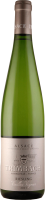 Trimbach F. E.
— Alsace
2021 Alsace AOC Riesling "Vieilles Vignes"
32.10 €
Trimbach F. E.
— Alsace
2021 Alsace AOC Riesling "Vieilles Vignes"
32.10 €
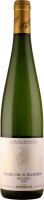 Trimbach F. E.
— Alsace
2019 Alsace AOC Riesling Grand Cru "Schlossberg"
52.20 €
Trimbach F. E.
— Alsace
2019 Alsace AOC Riesling Grand Cru "Schlossberg"
52.20 €
The most important grape varieties
More information in the magazine
- Second row, my ass! BEST OF Silvaner
- Domaine Robert Haag & Fils Riesling 2010, Scherwiller, Alsace, France
- Plaimont - The vine rescuers from south-west France Advertisement
- Good Bordeaux doesn't have to be expensive! Crus Bourgeois
- Paradisiacal times! Tasting: European sparkling wines for the festive season
- Liv-ex classification: The fine wine market 2023 France is the measure of all things
- Domaine Combier Collection of the Year 2022 - Rhône
- The collections and discoveries of the year 2022/2023 tasting season
- Social responsibility in the name of wine In Focus: Vignerons Engagés
- AB, Vignerons Engagés, HVE, Terra Vitis: what are the differences? Organic certifications for French wine