| West-Steiermark |
Description to West-Steiermark
One of the three specific wine-growing areas in the Austrian province or generic wine-growing region of Styria. The elongated area borders Slovenia in the south. In fact, Western Styria is in the south-west of Styria; large parts of Upper Styria lie further west than Western Styria. The name derives from the time of the Habsburg monarchy, when Eastern and Western Styria together formed Central Styria of the Duchy of Styria, while Lower Styria, now Slovenian, was the mixed-language German-Slovenian area with the capital Maribor. A viticulture can be traced back to the fourth century BC, as the Illyrians, Celts and later the Romans already cultivated vines here. In 1235, viticulture on the Ligistberg was first mentioned in a document.
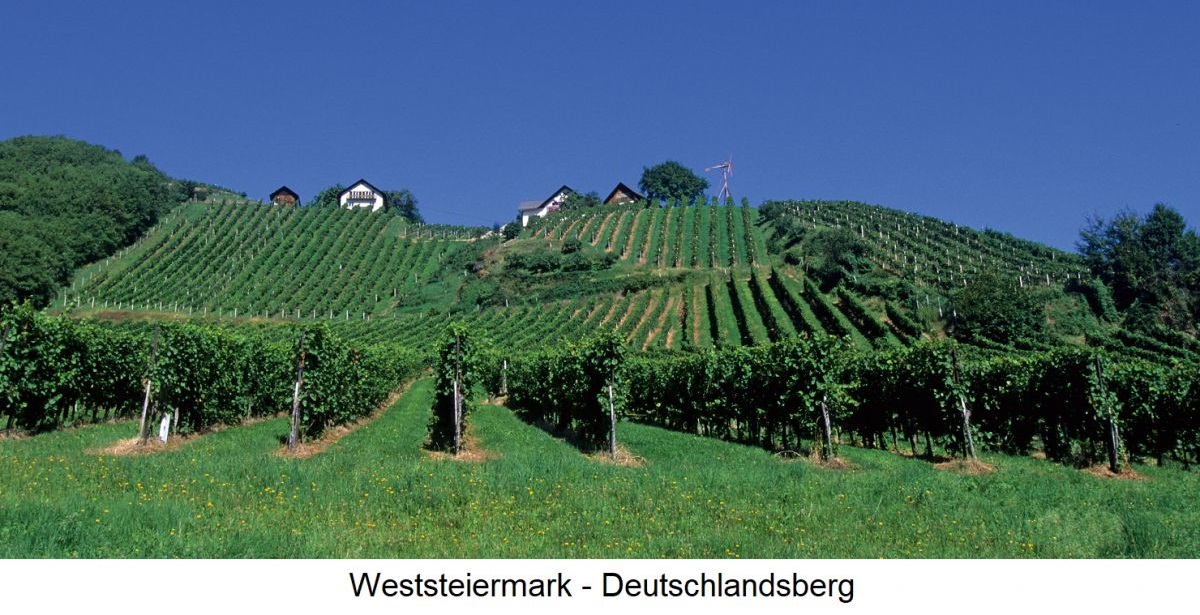
Climate & Soil
The location at the foothills of the Koralpe and the Reinischkogel protects against wind and causes strong warming during the day. The vineyards on gneiss and slate weathered soils extend in a narrow, long band between 420 and 600 metres above sea level southwards to the Slovenian border. Steep slopes and almost gorge-like valleys characterise the picture of the wine communities. The climate is Illyrian with southern European-Mediterranean influences and relatively high precipitation.
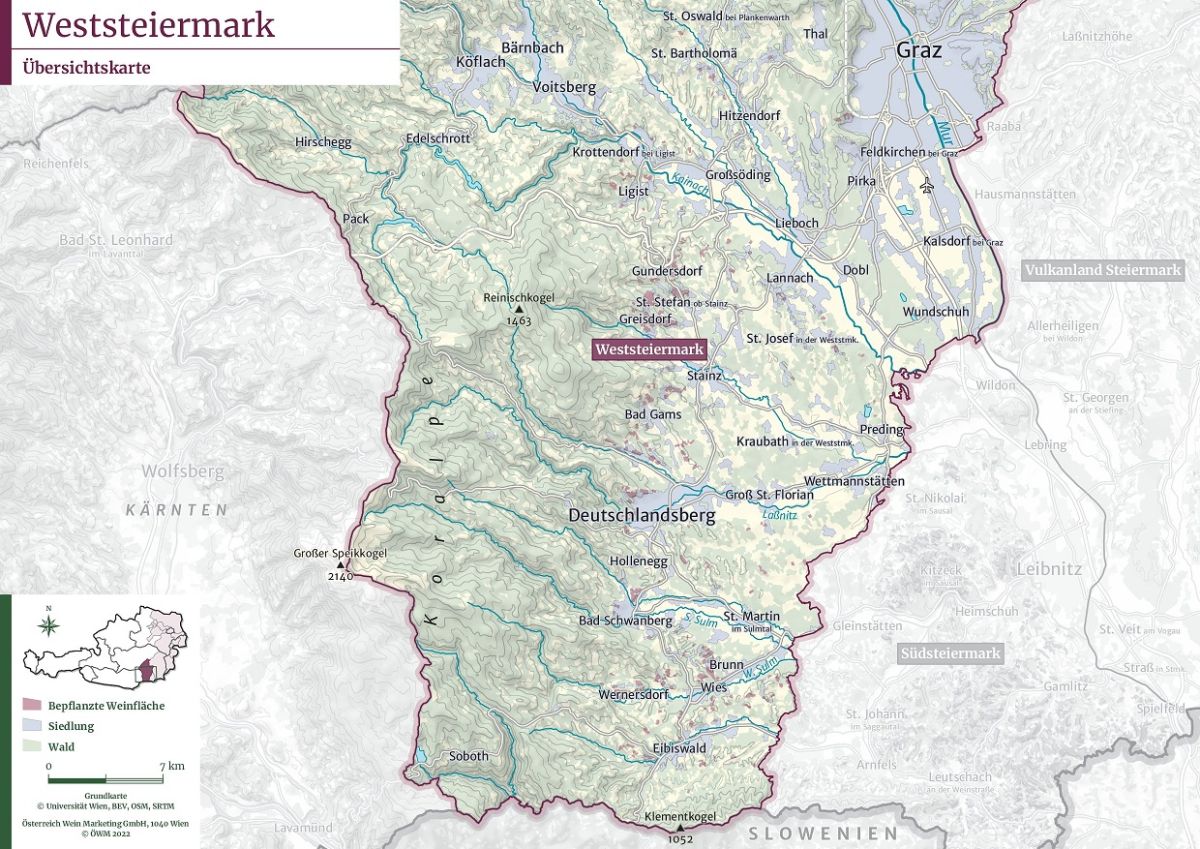
Wine-growing communities
Well-known wine-growing communities are Bad Gams, Deutschlandsberg (Riede Burgegg), Eibiswald, Groß St. Florian, Ligist, Marhof, Schwanberg, the Schilcher centre Stainz (Riede Engelweingarten), Stallhofen, St. Stefan ob Stanz, Gundersdorf, Greisdorf and Wies (Riede Lamberg). The "Schilcher Wine Route" begins in Ligist, passes through the most important villages and ends in Eibiswald. Characteristic are the "Kellerstöckln", which consist only of a pressing room with a wine cellar below.
Schilcher wine
Western Styria is the classic area of Schilcher wine, produced for centuries from the autochthonous Blauer Wildbacher variety, which is grown almost exclusively in Styria and occupies around two thirds of the vineyard area here. There is also an "Association for the Protection of the Classic Schilcher from Western Styria" with the trademark White Horse. The area covers the entire wine-growing region of Western Styria and, as a novelty outside of it, the cadastral municipality of Obergreith (municipality of Oberhaag in the district of Leibnitz) in the wine-growing region of Southern Styria.
Grape variety list
In 2022, the vineyards covered a total of 641 hectares of vines. Compared to 2016 with 546 hectares, this was an increase of 93 hectares (17%). Of these, white wine varieties account for 218 hectares (34%) and red wine varieties for 423 hectares (66%). Among the red wine varieties, the Styrian speciality Blauer Wildbacher dominates with almost two thirds of the total area, followed by Zweigelt and Blauer Burgunder. Among the white wine varieties, Pinot Blanc dominates, followed by Sauvignon Blanc and Welschriesling. There were no major changes in the ranking.
Grape variety
|
in Austria
|
Colour |
HA
|
%
|
HA
|
%
|
| Blue Wildbacher | - | red | 401 | 62,6 | 365 | 67 |
| White Burgundy | Pinot Blanc, Klevner | white | 54 | 8,4 | 45 | 8,2 |
| Sauvignon Blanc | Muscat Sylvaner | white | 53 | 8,3 | 33 | 6,1 |
| Welschriesling | - | white | 29 | 4,5 | 19 | 3,5 |
| Muscat Blanc | Yellow M., Red M. / Muscat Blanc | white | 28 | 4,4 | 14 | 2,5 |
| Chardonnay | - | white | 17 | 2,6 | 16 | 2,8 |
| Zweigelt | Blue Zweigelt, Rotburger | red | 9 | 1,4 | 12 | 2,1 |
| Muscaris | - | white | 7 | 1,1 | ||
| Müller-Thurgau | Rivaner | white | 6 | 0,9 | 5,1 | 0,9 |
| Grey Burgundy | Pinot Gris, Ruländer | white | 6 | 0,9 | 2,1 | 0,4 |
| Souvignier Gris | - | white | 5 | 0,8 | - | - |
| Scheurebe | seedling 88 | white | 4 | 0,6 | 3,2 | 0,6 |
| White Riesling | Riesling, Rhine Riesling | white | 3 | 0,5 | 1,4 | 0,3 |
| Pinot Noir, Pinot Noir | Pinot Noir, Blue Pinot Noir | red | 2,5 | 0,4 | - | - |
| Traminer | Gewürztraminer, Red T., Yellow T. | white | 2 | 0,2 | 0,5 | 0,1 |
| Flower muscatel | - | white | 1,2 | 0,2 | - | - |
| Sylvaner | Green Sylvaner | white | 1 | 0,2 | 1,0 | 0,2 |
| Goldburger | - | white | 1 | 0,1 | 0,8 | 0,2 |
| Rose muscatel | - | red | 0,6 | 0,1 | - | - |
| St. Laurent | - | red | 0,5 | - | 0,3 | 0,1 |
| Merlot | - | red | 0,5 | - | 0,3 | 0,1 |
| Syrah | Shiraz | red | 0,4 | 0,1 | - | - |
| Blauburger | - | red | 0,3 | - | - | - |
| Muscat Ottonel | - | white | 0,2 | - | - | - |
| Roesler | - | red | 0,2 | - | - | - |
| Blaufränkisch | - | red | 0,1 | - | 0,2 | - |
| Grüner Veltliner | - | white | 0,1 | - | - | - |
| other varieties | - | white/red | 12 | 1,8 | 309 | 5,5 |
WHITE SORT |
|
white |
218 |
34 |
157 |
29 |
RED SORT |
|
red |
423 |
66 |
389 |
71 |
TOTAL |
|
|
641 |
|
546 |
|
DAC system
The Western Styria DAC area comprises the political districts of Graz, Graz-Umgebung, Deutschlandsberg and Voitsberg. The cross-local wine-growing communities are Deutschlandsberg, Eibiswald, Ligist and Stainz. The leading varieties are the red wine Blauer Wildbacher (vinified as Schilcher) and the white wine Sauvignon Blanc.
In 2018, the origin-oriented DAC system was introduced in Styria. All other quality wines must be marketed with the origin Steiermark, the Land wines under the winegrowing region designation Steirerland. In contrast to the Austrian provinces of Burgenland and Lower Austria (where the individual areas were implemented one after the other), an overall concept was developed for all three specific wine-growing regions. There is a three-level pyramid of origin with the levels of area wine, local wine and Riedenwein. The DAC pyramid:
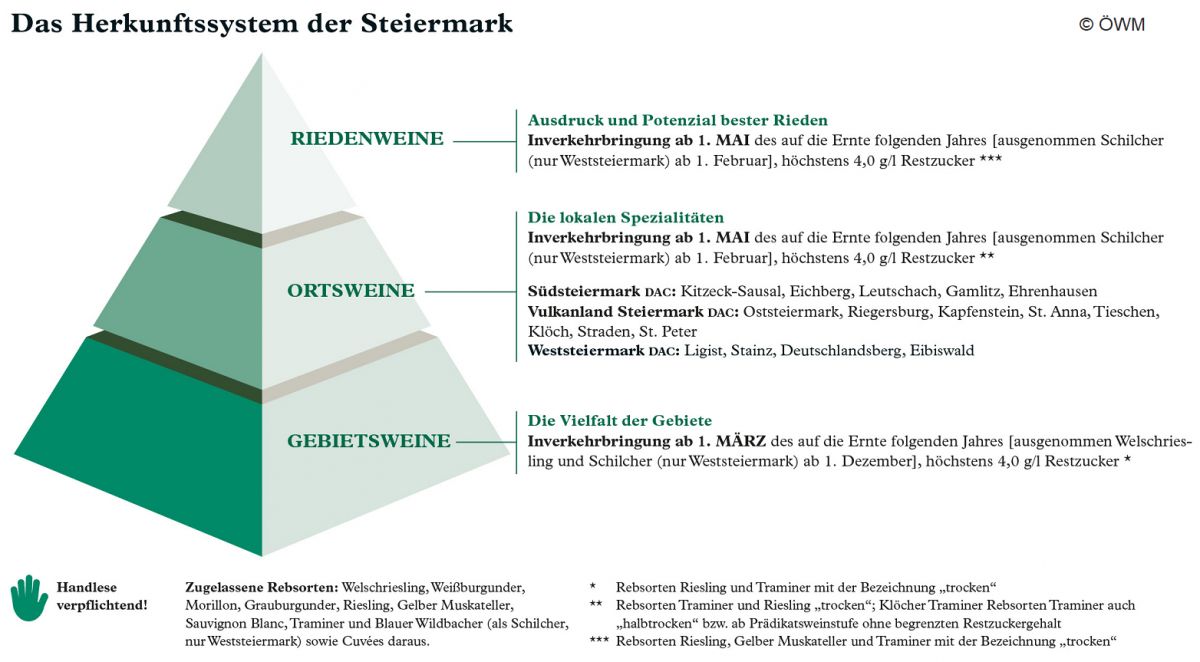
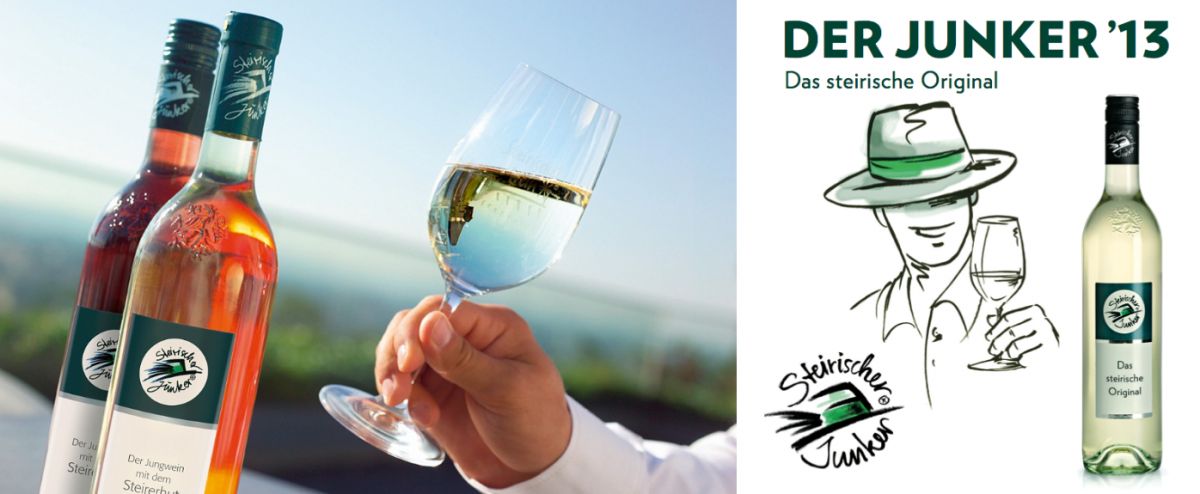
Styrian varietal diversity is taken into account in different ways (see the varieties in the graphic above). In the case of regional wine, it is preserved; in the case of local wine and partly also in the case of Riedenwein, local leading varieties have been defined differently for each wine-growing region. The regional wines may be marketed from 1 March, the single vineyard wines and the local wines from 1 May of the year following the harvest. Exceptions are the wines from the varieties Welschriesling and Schilcher Klassik (only in Western Styria), which may be marketed as regional wines as of 1 December of the year of harvest and as local wines as of 1 February of the year following the harvest. Likewise, an exception applies to the branded wine Steirischer Junker created by Verein Wein Steiermark, which is traditionally presented at the beginning of November.
Producers
Well-known wineries are Domäne Müller, Erzherzog Johann Weine, Friedrich Christian, Jöbstl Johannes, Langmann, Lazarus, Oswald Eduard, Reiterer Christian, Resch-Longus, Strohmeier and Weinhof Florian.
Deutschlandsberg: © ÖWM - Armin Faber
Map and DAC pyramid: © ÖWM
Styrian Junker: Toni Muhr
Classified wine producers in West-Steiermark 8



find+buy for West-Steiermark 5



Recent wines 94
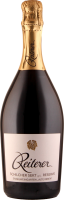 Weingut Christian Reiterer
— Styria/Steiermark
West-Steiermark Ried Engelweingarten Sekt g.U. Reserve Brut Schilcher, Alte Reben
21.50 €
Weingut Christian Reiterer
— Styria/Steiermark
West-Steiermark Ried Engelweingarten Sekt g.U. Reserve Brut Schilcher, Alte Reben
21.50 €

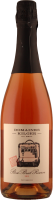 Domaines Kilger GmbH & Co.KG
— Styria/Steiermark
2015 West-Steiermark Sekt g.U. Reserve Brut Rosé
34.90 €
Domaines Kilger GmbH & Co.KG
— Styria/Steiermark
2015 West-Steiermark Sekt g.U. Reserve Brut Rosé
34.90 €
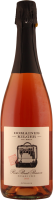 Domaines Kilger GmbH & Co.KG
— Styria/Steiermark
2015 West-Steiermark Sekt g.U. Reserve Zero Dosage Rosé Brut
34.90 €
Domaines Kilger GmbH & Co.KG
— Styria/Steiermark
2015 West-Steiermark Sekt g.U. Reserve Zero Dosage Rosé Brut
34.90 €
 Weingut Langmann - Vulgo Lex
— Styria/Steiermark
West-Steiermark Brut
85 WP
very good
Weingut Langmann - Vulgo Lex
— Styria/Steiermark
West-Steiermark Brut
85 WP
very good
The most important grape varieties
More information in the magazine
- Discover Chardonnay in an entirely new way Unusual pairing tips from René Kollegger
- Sauvignon Blanc above all Wine-growing regions in Austria: Südsteiermark
- In the land of the Schilcher Wine-growing regions in Austria: Weststeiermark
- On a pleasure trip through the Vulkanland Steiermark Insider tips: Wine, specialities and delicacies
- Weingut Gross - The art of winemaking - Advertisement -
- In Focus: Styrian Sauvignon Blanc The red thread
- Styrian Sauvignon Blanc: great vintages now available People in Styria will be talking about 2019, 2020 and 2021 for a long time - Advertisement -
- Collection of the Year 2021 - Styria Neumeister Winery
- Hail protection versus landscape protection How the use of hail nets is changing viticulture in Austria
- Austria In Focus Styrian single vineyards