Wine regions in País Vasco/ Euskadi 5 growing regions
Description to País Vasco/ Euskadi
The Basque Country is a landscape on the Atlantic coast in the border region of the countries Spain and France. The Autonomous Region of the Basque Country in Spain is not identical with the Basque Country in the cultural sense, which also includes the French Basque Country and the region of Navarre (Basque Nafarroa), which is Basque mainly in its northwest.
Basque Country France
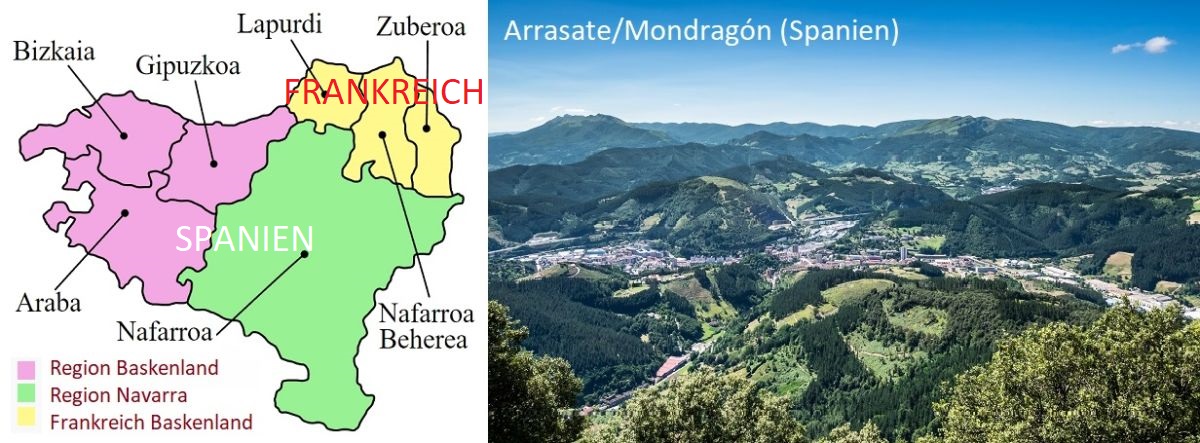
The French Basque Country (French: Pays Basque, Basque: Iparralde = northern Basque Country) forms the western part of the department of Pyrénées-Atlantiques in south-western France. It is divided into three areas marked in yellow on the map: Labourd (Basque Lapurdi), Lower Navarre (French Basse-Navarre, Basque Nafarroa Beherea) and Soule (French also Pays de Soule, Basque Zuberoa). The two AOC areas of Béarn and Irouléguy are located here.
Basque Country Spain
The Spanish Autonomous Region of the Basque Country (Basque Euskal Herria or Euskadi, Spanish País Vasco or Vasconia) with its capital Vitoria-Gasteiz covers a total of 7,230 km² and is divided into the three provinces of Gipuzkoa (Spanish Guipúzcoa), Biscay (Basque Bizkaia, Spanish Vizcaya) and Álava (Basque Araba), which are marked in pink on the map.
History
There is documentary evidence that Txakolí wines were produced as early as the 9th century. At that time, however, it was produced in the interior of the Basque Country and not mainly in the coastal area, as is the case today. Naturalist Alexander von Humboldt (1769-1859) liked Txakolí so much that he compared it to the local Rhine wine.
Climate & Soils
Under the influence of the Atlantic Ocean, the climate is mild but humid with abundant rainfall. The clayey soils are partly mixed with gravel and have a high organic content.
Vineyards and grape varieties
The vineyards cover a total of 13,500 hectares. The grape varieties are listed below.
Vineyard areas
There are three DO areas (quality wines). A special feature is that vineyards in the very south of the province of Alava belong to the DO area Rioja (Rioja Alavesa).
- Chacolí de Alava (Basque Arabako Txacolina) - in the province of Álava in the interior of the country
- Chacolí de Bizkaia (Bizkaiko Txacolina in Basque) - in the province of Biscay from the coast to the hinterland
- Chacolí de Getaria (Basque: Getariako Txacolina) - near the fishing and port town of Getaria.
Until the phylloxera outbreak, there were over 1,000 hectares of vines here. The vineyards on clay, limestone and chalk soils are tiny and widely scattered. There is abundant rainfall, but also plenty of sun, and the vines are raised on pergolas. Over 80% acidic, low alcohol, naturally carbonated white wines are made from the Hondarrabi Zuri (Courbu Blanc) variety with small amounts of Petit Manseng, Petit Courbu, Gros Manseng and Folle Blanche, as well as Chardonnay and Sauvignon Blanc. The red wine is produced from the Hondarribi Beltza variety.
Picture left: by Unai Fdz. de Betoño, based on User:Willtron - Mapa, CC BY-SA 1.0, Link
Image right: by Basotxerri - Own work, CC BY-SA 4.0, Link
find+buy for País Vasco/ Euskadi 35



Recent wines 20
 Bodega de Txakolli Talai Berri
— País Vasco/ Euskadi
2017 D.O. Getariako Txakolina
Up to 10.00 €
Bodega de Txakolli Talai Berri
— País Vasco/ Euskadi
2017 D.O. Getariako Txakolina
Up to 10.00 €
 Aizpurua
— País Vasco/ Euskadi
2016 D.O. Getariako Txakolina Jazinto Aizpurua
Aizpurua
— País Vasco/ Euskadi
2016 D.O. Getariako Txakolina Aizpurua. B
Aizpurua
— País Vasco/ Euskadi
2016 D.O. Getariako Txakolina Aialle
Aizpurua
— País Vasco/ Euskadi
2016 D.O. Getariako Txakolina Jazinto Aizpurua
Aizpurua
— País Vasco/ Euskadi
2016 D.O. Getariako Txakolina Aizpurua. B
Aizpurua
— País Vasco/ Euskadi
2016 D.O. Getariako Txakolina Aialle
The most important grape varieties
More information in the magazine
- The collections and discoveries of the year Tasting season 2023/2024
- Our wine tips for the barbecue: From the Wachau to the Priorat Currently tasted
- Paradisiacal times! Tasting: European sparkling wines for the festive season
- Elegant balance between extremes In FocusDO Rueda
- Turnkey vineyards for the holiday finca Interview: Mallorca winemaker Henri Fink
- "Sustainability is part of our family's DNA" Vicky Gonzalez-Gordon of Gonzalez Byass on wine and sherry in climate change
- Montsant More radiant with every step
- The terroir of the Montsant Rocks, mountains and gentle river valleys in the south
- History of viticulture in the Montsant Of Roman amphorae, phylloxera and wine cathedrals
- Discover Montsant Enjoy wine, experience nature, experience culture