| OEOP Commandaria |
Description to OEOP Commandaria
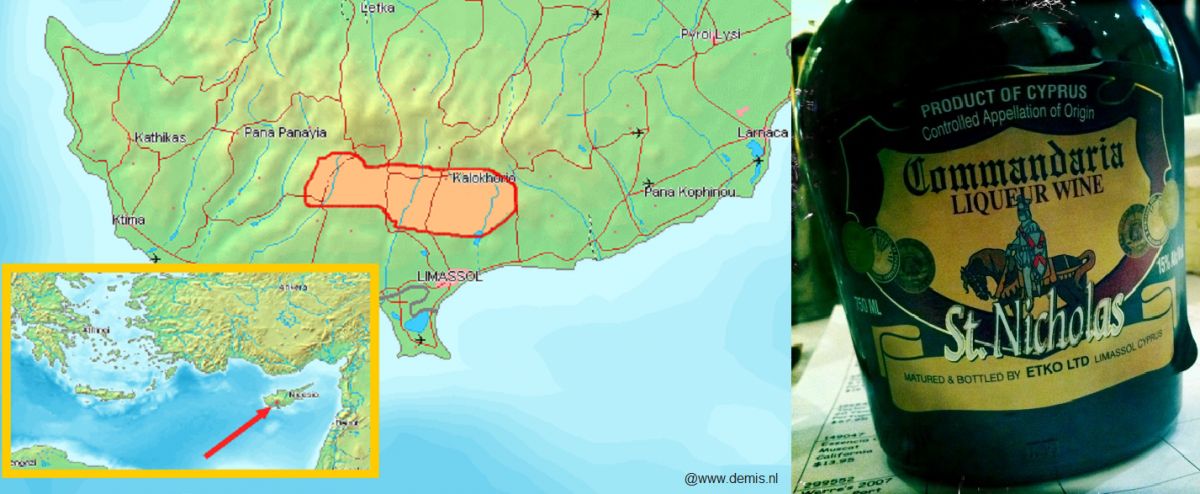
A quality wine area(PDO) on the island of Cyprus within the southern part of the island (Greek Republic of Cyprus) in the Mediterranean Sea. It produces the famous sweet wine Commandaria (Koumandaria, Commanderia, Coumadarka, Κουμανδαρία), which is one of the oldest wines in the world. Based on archaeological excavations, its history dates back to around 3500 BC. In the 8th century BC, the Greek poet Hesiod (~750-680 BC) described a sweet wine called Mana. The translation of "mana" is "mother", which refers to the process of creation. In 734 BC, Hesiod describes the harvesting of the grapes and the making of the wine as follows:
"When Orion and the star of the dog (Sirius) move to the centre of the firmament, cut off the grapes and lay them in the sun (to dry) for ten days and nights. Then store them in the shade for another five days and fill them into jars on the sixth day. Then it becomes wine as a gift from (the wine god) Dionysus". The English king Richard the Lionheart (1157-1199) conquered the island of Cyprus in 1191 during the Third Crusade. At his wedding to Berengaria (1165-1230), a sweet wine was served that is considered the forerunner of Commandaria and was expressly praised by the king.
Order of St John
A few years later, the Order of St John (Knights of St John of Jerusalem) settled on the island and began to perfect the production of the sweet wine "Nama". They had their headquarters at Kolossi Castle "Grand Commandery", from which the name "Commandaria" is derived. During the Frankish rule (1192-1489) and the Venetian rule (1489-1571), Cypriot wines were exported to all the important trading centres of the time and supplied to many European ruling houses, such as the Habsburg house in Vienna (Austria). Commandaria was also used as a medicine against jaundice by soaking mandrake twigs in it. During the British Mandate over Cyprus from 1878 to 1960, the wine also became popular in Britain.
Winegrowing area
There has been a protected designation of origin Commandaria since 1973. The wine must come from one of the 14 communes in the foothills of the Troodos Mountains north of the port city of Lemesos (Limassol) in the south of the island. The best wine qualities come from the municipalities of Ayios Constantinos, Ayios Pavlos, Kalo Horio, Louvaras and Zoopigi. The climate is Mediterranean, with hot, dry summers and mild winters. The mostly terraced vineyards cover around 2,000 hectares at 400 to 900 metres above sea level on barren, stony ground.
Cyprus has never been affected by phylloxera; the vines, which can be over 100 years old, are cultivated ungrafted. The traditionally bush-grown varieties Xynisteri (white) and Mavro (red) are permitted. The vine density must be at least 2,000 vines/ha, the yield is limited to a maximum of 6,000 kg/ha of grapes. There must be no artificial irrigation. The grapes must have at least 204 g/l for Xinisteri (12% potential alcohol content) and 230 g/l for Mavro (13.5%). They are sun-dried for about 10 days and reach at least 374 g/l of sugar. The grapes are harvested at the beginning of September.
Production
Most of the base wines are sold to the four large wineries Etko, Keo, Loel and Sodap, which carry out the further vinification. Due to the high sugar content, the fermentation lasts for two to three months. The alcohol content must be at least 9.5% vol. The wine is now fortified with high-percentage ethyl alcohol (at least 96%) or brandy (maximum 86%) to at least 15 to maximum 18% alcohol by volume. The potential alcohol content must be at least 22% vol. This is followed by at least two years of maturation in oak or chestnut barrels. According to the traditional Mana method (see above), old wines are blended with young ones, similar to the solera method used for sherry. However, there are also small quantities of vintage wines. Depending on the maturation period, there are the designations:
- Aged for at least 2 years
- Very Aged for at least 4 years
- Exceptionally or Exceptionally Aged for at least 8 years
- Rarely or Rarely Aged for at least 12 years
Bottling & wine description
The wine is usually bottled in Cognac or Bocksbeutel-like bottles. The extract-rich, creamy sweet wine is amber to dark reddish-brown in colour and has a pronounced aroma of coffee, dried fruit and wild berries with lively acidity. It is characterised by Langlebigkeitlongevity or decades of shelf life and should be drunk as cool as possible. Also known as the "apostle of wines", it is also popular as a mass wine in Cyprus.
Picture left: By Scops - Own work, CC BY-SA 3.0, Link
Image right: By Greencolander - flickr photo, CC BY 2.0, Link
Recent wines 6

 LOEL Ltd
— Limassol
2004 OEOP Commandaria Alasia
26.95 €
SODAP & Kamanterena Wineries
— Limassol
2002 OEOP Commandaria Saint Barnabas
35.95 €
LOEL Ltd
— Limassol
2004 OEOP Commandaria Alasia
26.95 €
SODAP & Kamanterena Wineries
— Limassol
2002 OEOP Commandaria Saint Barnabas
35.95 €