Wine regions in France 43 growing regions
Description to France
The Republic of France with its capital Paris covers 632,734 km². It is an intercontinental state in Western Europe with overseas territories. The national territory is located on all continents with the exception of Asia. The European part of the national territory (France métropolitaine) covers 543,940 km² (85%) and borders Spain and Andorra to the south-west, Belgium, Luxembourg, Germany, Switzerland and Italy to the north and east, and Monaco to the south-east. The island of Corsica (8,760 km²) is a French territorial entity with special status. It is much closer to Italy than France.
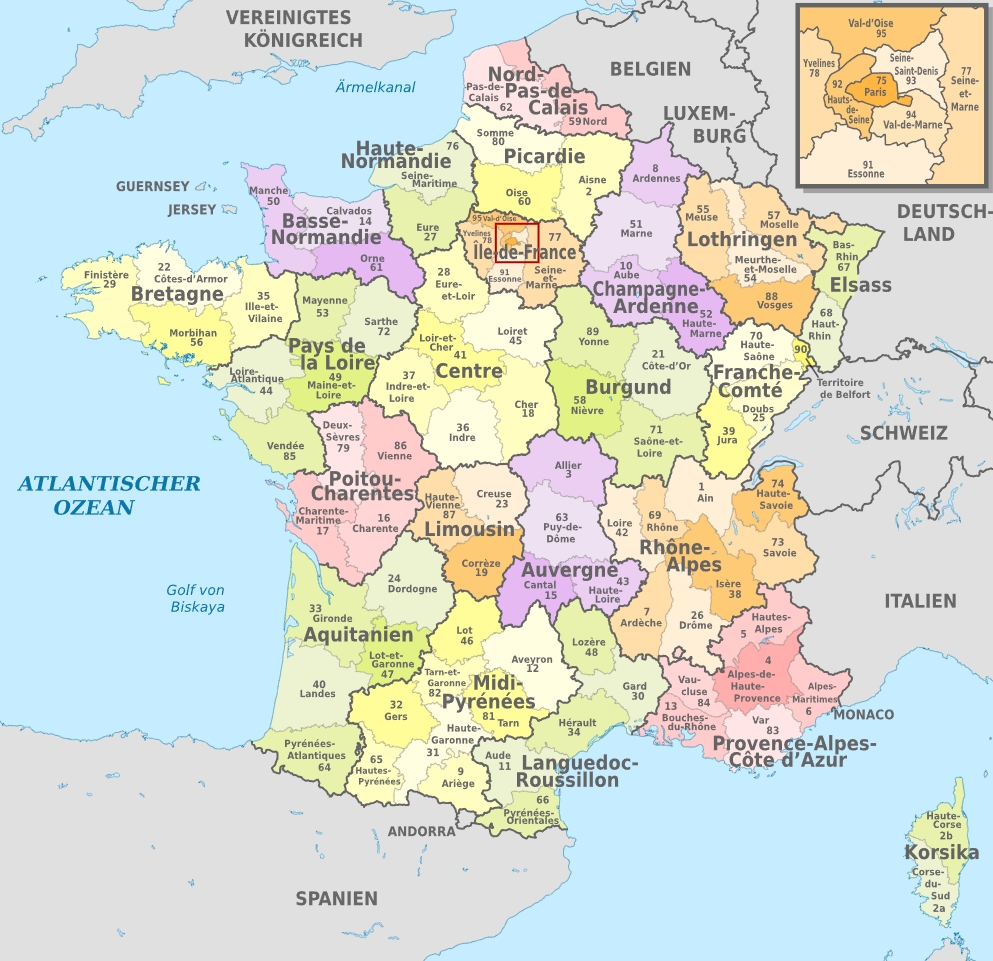
The overseas territories outside the heartland are known as "Départements et régions d'outre-mer" (DOM) and cover 88,794 km² (roughly the same as Austria). They are former French colonies. These are Guadeloupe and Martinique (island groups in the Caribbean), French Guiana (in the north of South America on the Atlantic Ocean between Brazil and Suriname), Réunion (island in the Indian Ocean) and Mayotte (island north-west of Madagascar).
The country is administratively divided into 23 regions with a total of 101 departments (96 of which are in Europe). Understandably, there is only significant viticulture in the European area. The wine-growing areas are distributed fairly evenly over three quarters of the surface area, especially along the many bodies of water (see below).
History
Compared to Greece and Italy, France is a relatively young wine-growing country. The first vines were introduced in the 6th century BC by the Greeks, who founded Massalia (lat. Massillia = Marseille) in the south-west on the Mediterranean coast. At this time, the land later called Gaul by the Romans was inhabited by various Celtic tribes (Allobroges, Ambians, Arvernes, Biturians, Cenomanians and others in France, Norics in Bavaria and Austria).
A lively trade developed and the Greeks met the demand. When they immigrated to the Po Valley in the 5th century, they learnt about Italian wine and began to import it. The French had therefore been consuming wine for a long time before they began to cultivate it themselves on a large scale. The conquest of Gaul by Julius Caesar (100-44 BC) led to the systematic spread of wine in the Rhône valley in the 1st century, in Burgundy and Bordeaux in the 2nd century and in the Loire in the 3rd century. The Roman Emperor Marcus Aurelius Probus (232-282) lifted the ban imposed by Emperor Domitian (51-96) and ordered the planting of vines throughout Gaul in the middle of the 3rd century.
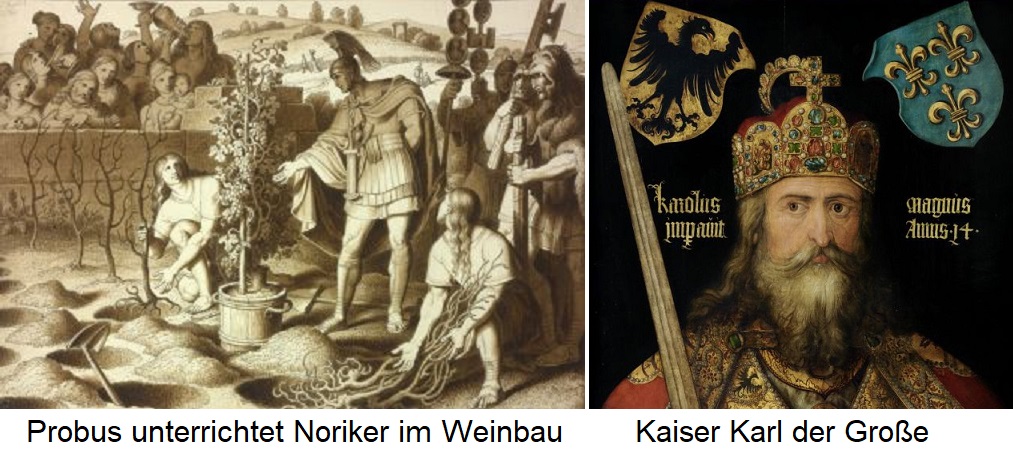
Charlemagne
The King of the Franks and later Emperor Charlemagne (742-814) gave decisive impetus to viticulture in present-day France through his decrees. The Catholic order of Cistercians was founded in the monastery of Cîteaux in Burgundy in 1098 and quickly spread throughout Europe. The monks perfected viticulture in terms of soil type selection, grape variety selection and winemaking, which had an impact throughout Europe. However, the Benedictine order, whose most famous member was probably Dom Pierre Pérignon (1638-1715), the "inventor" of assemblage, the skilful blending of wines, made an equally significant contribution to viticulture. It is also worth mentioning that wine was included in the French revolutionary calendar, and September was given the name Vendèmiaire (wine month).
Bordeaux classification
The famous Bordeaux classification took place in 1855. This had a major influence on the later quality class systems, which vary greatly from region to region. Shortly afterwards, the country was the starting point of the greatest and most comprehensive disaster in the history of viticulture, when phylloxera and powdery and downy mildew began their campaign of destruction across Europe from the 1860s onwards. France was particularly badly affected, with over three-fifths (700,000 hectares) of its vineyards destroyed. At the same time, however, the "Golden Years of Bordeaux" signalled a new beginning when vineyards were planted on a large scale in the Médoc.
The concept of terroir
In France, it was recognised early on that a wine with unmistakable characteristics is produced on a specific soil, under the influence of the local microclimate and specially selected grape varieties. The Cistercians laid the foundations as early as the Middle Ages. The term terroir was coined in the first third of the 20th century. In the 1920s, vineyard owner Pierre Le Roy de Boiseaumarié (1890-1967) described the ideal grape varieties for Châteauneuf-du-Pape based on the typical soil and climate in an area he defined. Further impetus came from Joseph Capus (1868-1947), who together with Boiseaumarié is considered the initiator of the appellation system.
Wine-growing regions
France was the first country to geographically map its wine-growing regions. This was done by defining legally valid areas and boundaries from which the specific quality of a wine can be clearly derived. This is clearly and unmistakably defined by the appellation in question. The better the wine, the more precise the regulations and, as a rule, the smaller the area. The special system of "controlled origin" is described under Appellation d'Origine Protégée; it is controlled by the INAO authority. The wine-growing areas are mainly located along the many rivers such as the Dordogne, Garonne, Gironde, Loire and Rhône, as well as their numerous tributaries. Under the protection and supervision of the INAO, there are around 400 AOP areas(quality wines) and around 100 IGP areas(regional wines). In contrast to Italy (where this is 100% identical), there is hardly any correspondence between the wine-growing regions and the political borders:
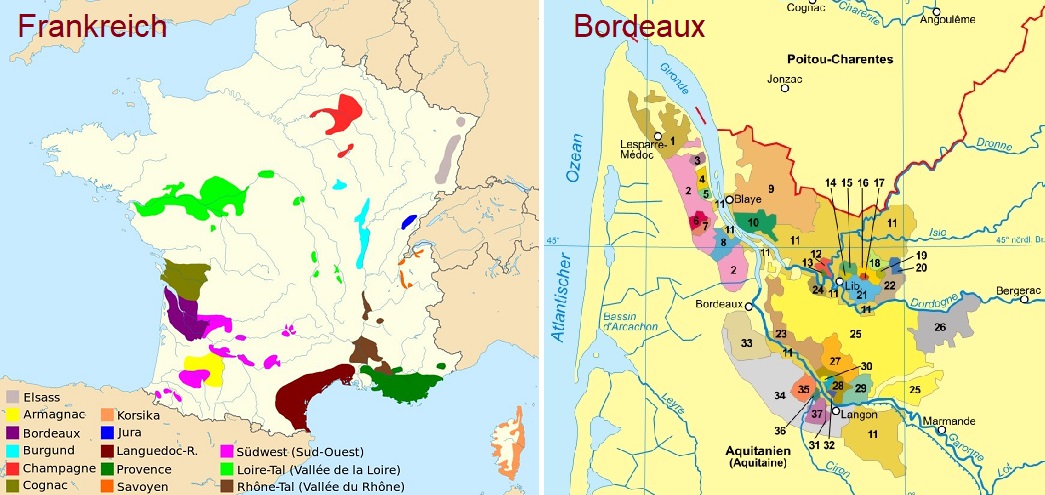
Wine-growing region |
Départements |
Main towns |
hectares |
| Armagnac | Gers, Landes, Lot-et-Garonne | Also | 12.000 |
| Bordeaux | Gironde | Bordeaux | 113.000 |
| Burgundy | Côte d'Or, Saône-et-Loire, Nièvre, Sâone-et-Loire | Dijon | 40.000 |
| Champagne | Ardennes, Aube, Marne, Haute-Marne | Épernay, Reims | 34.000 |
| Cognac | Charente | Cognac | 75.000 |
| Alsace | Bas-Rhin, Haut-Rhin | Strasbourg | 15.000 |
| Jura | Jura | Lons-le-Saunier | 1.900 |
| Corsica | Corse-du-Sud, Haute-Corse | Ajaccio | 7.500 |
| Languedoc | Ardèche, Ariège, Aveyron, Haute-Loire, Gard, Gers, Hautes-Pyrénées, Hérault, Lot, Lòzere, Tarn, Tarn-et-Garonne, Pyrénées-Orientales | Montpellier, Toulouse | 201.000 |
| Loire | Loire-Atlantique, Maine-et-Loire, Mayenne, Sarthe, Vendée | Angers, Nantes, Saumur | 70.000 |
| Lorraine | Meurthe-et-Moselle, Meuse, Moselle, Vosges | Metz | 125 |
| Provence | Alpes-de-Haute-Provence, Bouches-du-Rhône, Var, Vaucluse, Hautes-Alpes, Alpes-Maritimes |
Aix-en-Provence, Avignon, Marseille, Nice | 25.000 |
| Rhône | Ain, Ardèche, Drôme, Isère, Loire, Rhône, Savoie, Haute-Savoie | Lyon, Montélimar | 80.000 |
| Roussillon | Pyrénées-Orientales | Perpignan | 23.000 |
| Savoy | Haute-Savoie, Savoie | Chambéry | 2.100 |
| South-west France | Arriège, Aude, Aveyron, Cantal, Charente, Charente-Maritim, Dordogne, Gers, Gironde, Hautes-Pyrénées, Landes, Lot, Lot-et-Garonne, Pyrénées-Atlantiques, Tarn |
Angoulême, Carcassonne, Montauban | 160.000 |
Grape varieties and vineyards
Different philosophies and styles prevail with regard to grape varieties. In the south and south-west, especially in Bordeaux, red wines in particular are blended from several varieties, the classic cuvées for which the term Bordeaux blend is used. In the more northerly regions, however, such as Chablis, Alsace, Loire, Savoy and especially Burgundy, the wines are usually made from a single grape variety. The system of vineyard sites and the associated classification system is particularly pronounced in Burgundy. Between 1988 and 2010, around 180,000 hectares of vineyards were cleared as part of EU grubbing-up programmes. This mainly affected Languedoc-Roussillon.
There are 70,000 winegrowing businesses with an average of nine hectares of vineyards. Around 45% process the grapes themselves and produce 55% of the production, the rest are supplied to winegrowers' co-operatives. They produce 45% red wines, 43% white wines (the majority in brandy) and 12% rosé wines. Around 62% are AOP wines, 18% IGP wines and 20% Vin de France.
In 2022, the vineyards covered 795,286 hectares of vines and the wine production volume was 45.6 million hectolitres. This puts France among the world leaders. The grape variety index with the top 50 (Kym Anderson statistics):
| Grape variety | Colour | Synonyms or French name | Hectare |
| Merlot | red | - | 108.483 |
| Trebbiano Toscano | white | Ugni Blanc | 78.842 |
| Garnacha Tinta | red | Grenache Noir | 78.631 |
| Syrah | red | - | 62.211 |
| Chardonnay | white | - | 47.451 |
| Cabernet Sauvignon | red | - | 46.555 |
| Cabernet Franc | red | - | 32.327 |
| Mazuelo | red | Carignan | 31.760 |
| Pinot Noir | red | - | 31.602 |
| Sauvignon Blanc | white | - | 28.084 |
| Gamay | red | Gamay Noir | 24.095 |
| Cinsaut | red | Picardan Noir | 15.930 |
| Pinot Meunier | red | - | 12.130 |
| Sémillon | white | - | 10.234 |
| Melon de Bourgogne | white | Melon | 9.550 |
| Chenin Blanc | white | - | 9.432 |
| Viognier | white | - | 8.823 |
| Monastrell | red | Mourvèdre | 8.754 |
| Colombard | white | - | 8.441 |
| Muscat Blanc / Muscat | white | - | 7.333 |
| Cot | red | Côt, Malbec, Pressac | 6.100 |
| Garnacha Blanca | white | Grenache Blanc | 5.130 |
| Vermentino | white | Rollé | 4.642 |
| Riesling | white | - | 4.025 |
| Marselan | red | - | 3.662 |
| Gewürztraminer / Traminer | white | Gentil Rose Aromatique, Savagnin Blanc | 3.320 |
| Caladoc | red | - | 3.062 |
| Gros Manseng | white | - | 3.046 |
| Pinot Gris | white | - | 2.867 |
| Alicante Henri Bouschet | red | Alicante Bouschet | 2.607 |
| Tannat | red | - | 2.513 |
| Muscat d'Alexandrie | white | - | 2.462 |
| Auxerrois | white | Auxerrois Blanc | 2.409 |
| Muscat d'Hamburg | red | - | 2.325 |
| Clairette | white | Blanquette, Clairet, Clairette Blanche | 2.042 |
| Grolleau Noir | red | - | 1.949 |
| Aligoté | white | - | 1.927 |
| Roussanne | white | Petite Roussette, Roussanne Blanc | 1.831 |
| Macabeo | white | Maccabéo | 1.657 |
| Piquepoul Blanc | white | Picboul, Picpoul de Pinet | 1.564 |
| Folle Blanche | white | - | 1.554 |
| Mauzac Blanc | white | Mauzac, Mausac | 1.526 |
| Sangiovese | red | - | 1.503 |
| Fer | red | Fer Servadou | 1.502 |
| Marsanne | white | Marsanne Blanche, Roussette Grosse | 1.484 |
| Muscadelle | white | - | 1.412 |
| Garnacha Roja | white | Grenache Gris | 1.253 |
| Petit Manseng | white | Manseng Blanc, | 1.247 |
| Pinot Blanc | white | Auvernat Blanc | 1.181 |
| Aramon Noir | red | - | 1.167 |
Wine categories / quality levels
In August 2009, the EU wine market regulation came into force with fundamental changes to wine designations and quality levels. The designation AOC may continue to be used as an alternative. The three quality levels are (see also in detail under Quality system):
- Vin de France (formerly Vin de table or table wine) = wine
- IGP (formerly Vin de pays) = country wine
- AOP (formerly AOC or AC) = quality wine
Vin de France (Vins sans Indication Géographique)
Wines without a geographical indication. It replaced the former designation Vin de table. Grape varieties from all over France are permitted. There are wines with and without an indication of grape variety and/or vintage. The INAO is not responsible, as is the case for quality wines and country wines, but the Anivin de France association.
IGP (Indication Géographique Protégée)
Wines with a protected geographical indication. Replaces the former designation Vin de pays. The wines are subject to less strict production guidelines. Although recommended grape varieties and maximum yields are defined, there is more room for manoeuvre than with AOP. Grape varieties other than those recommended can also be used. A hierarchical distinction is made between IGP régionales, IGP départementales and IGP de petites zones according to size or scope. The six largest regional IGP areas are Atlantique, Comté Tolosan, Comtés Rhodaniens, Méditerranée, Pays d'Oc and Val de Loire.
VDQS (Vin Délimité de Qualité Supérieure)
This level was created in 1949 as a preliminary stage for the AOC rank. The production guidelines must now be prepared according to AOP standards and the link to the terroir must be proven. These wines were thus classified as AOP.
AOP (Appellation d'Origine Protégée) or
AOC (Appellation d'Origine Contrôlée)
The new top of the quality pyramid. Compared to the old AOC, controls by independent bodies have been strengthened. There are three levels: AOP Cru (wines from a vineyard, site or parcel), AOP communal (wines from a commune) and AOP regional (wines from a region). See Appellation d'Origine Protégée for more details.
Special classification systems
In addition to the EU-compliant quality levels, there are sometimes confusing classification systems in France that vary from region to region. These are the Bordeaux classification for Médoc and Sauternes from 1855, the Burgundy classification, as well as the Graves and Saint-Émilion classifications, which are carried out at regular intervals. See a complete list under Grand Cru.
Institutions and committees
Influential French wine authors and wine critics are or were Michel Bettane, Guy Bonnefoit, Pierre Brejoux, Thierry Desseauve, Patrick Dussert-Gerber, Odette Kahn, Alexis Lichine, Émile Peynaud, Olivier Poussier, André Simon and Christian Vanneque. The most important wine magazines and guides include the four publications Guide des Vins, Hachette, Le Guide des Meilleurs Vins de France and Le Grand Guide des Vins.
In addition to national organisations, there are also some important international winegrowing institutions based in France for research and development, standards and norms, as well as professional associations. These are CPVO (Community Plant Variety Office), FIJEV (Federation Internationale des Journalistes et Ecrivains des Vins et Spiritueux), IFV (Institut Français de la Vigne et du Vin), INAO (Institut National des Appellations d'Origine), INRAE (Institut national de recherche pour l'agriculture, l'alimentation et l'environnement), ISVV (Institut des Sciences de la Vigne et du Vin), OIV (Organisation Internationale de la Vigne et du Vin) and UPOV (Union internationale pour la Protection des Obtentions Végétales).
Map of France: from TUBS - adapted, CC BY-SA 3.0, Link
Probus: History of Vienna WIKI
Charlemagne: From Albrecht Dürer - Public domain, Link
France: From French vineyards, France blank
Eric Gaba(Sting - fr:Sting) derivative work: Sdaubert (talk)
derivative work: Furfur (talk), CC BY-SA 2.5, Link
Bordeaux: By Domenico-de-ga, CC BY-SA 3.0, Link
Classified wine producers in France 745

find+buy for France 121



Recent wines 7295


 Mas du Novi
— Languedoc
2023 Languedoc AOP "Lou Rosat"
12.00 €
Mas du Novi
— Languedoc
2023 Languedoc AOP "Lou Rosat"
12.00 €
The most important grape varieties
More information in the magazine
- Plaimont - The vine rescuers from south-west France Advertisement
- Good Bordeaux doesn't have to be expensive! Crus Bourgeois
- Paradisiacal times! Tasting: European sparkling wines for the festive season
- Liv-ex classification: The fine wine market 2023 France is the measure of all things
- Domaine Combier Collection of the Year 2022 - Rhône
- The collections and discoveries of the year 2022/2023 tasting season
- Social responsibility in the name of wine In Focus: Vignerons Engagés
- AB, Vignerons Engagés, HVE, Terra Vitis: what are the differences? Organic certifications for French wine
- A lot of power for little money In Focus: Côtes du Rhône Villages Rouge
- Saving your account with pleasure In Focus: Crozes-Hermitage