| Bergerac AOC |
Description to Bergerac AOC
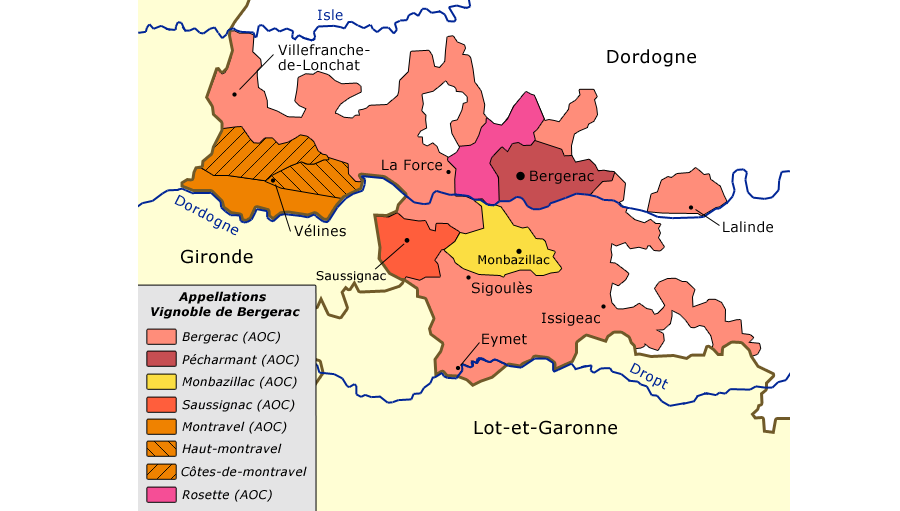
The appellation (also Bergeracois) is named after the town of the same name east of Bordeaux. With over 12,000 hectares of vineyards, it is the largest wine-growing region in southwest France. Wine is grown in about 90 of the 133 municipalities. They are located in the southeast of the Dordogne department along the river of the same name. As enclaves in this huge area there are the independent appellations Monbazillac, Montravel (with subappellations Côtes de Montravel and Haut-Montravel), Pécharmant, Rosette and Saussignac.
The Romans were already cultivating wine here in the 1st century and reached its highest flowering in the Middle Ages through the monasteries of the Benedictines and Cistercians. At that time, Bergerac was called Haut-Pays (Upper Country) together with other areas. For centuries Bergerac was in competition with its "big brother" Bordeaux and was also fought with unfair means. The Bergerac wines had to be shipped via the port of Bordeaux and small barrels were prescribed for the small neighbour. Since the customs duty was not calculated according to volume but according to the number of barrels, this made exportation more difficult, but nevertheless wine from Bergerac attained world fame at that time. A prominent lover was the Prussian King Frederick II the Great (1712-1786). After the Hundred Years' War (1337-1453) between England and France in the battle for French mainland (including Bordeaux), the Dutch wine trade dominated, and for two centuries it was used to promote sweet wine. The vineyards were about three times as large at that time.
The oceanic climate is characterised by heavy rainfall in spring and late autumn, hot and dry summers and mild winters. The frequent fog in the Dordogne valley favours the formation of botrytis (noble rot). To the north of Bergerac, the soil to the right of the river consists of gravel-sand sediments on a limestone base and further downstream of limestone with red clay. On the left bank, limestone with clay predominates. The most important red and rosé wines are Cabernet Sauvignon, Cabernet Franc, Merlot, Malbec(Cot), Fer and Mérille. The most important white wines are Sauvignon Blanc, Sémillon, Muscadelle, Ondenc, Chenin Blanc and Ugni Blanc(Trebbiano Toscano).
There are two different appellation designations for the red, rosé and white wines. The reason is not the terroir, as one might think because of the term "Côtes", but rather the different types of wine. Under Bergerac, fruity wines that can be drunk young are produced. The storable wines Côtes de Bergerac are subject to stricter conditions with lower yield and higher alcohol content. The designation Côtes de Bergerac moelleux applies only to sweet white wines made from dried grapes. Well-known producers in Bergerac are Château Bélingard, Château Court-les-Muts, Château de la Colline, Château de la Mallevieille, Château du Bloy, Château Grinou, Château la Plante, Château le Mayne, Château le Raz, Château Tour des Gendres, Clos d'Yvigne, Domaine Constant, Domaine de la Jaubertie, Domaine de Richard and Domaine Grand Maison
Map: From Cyril5555 - Own work, CC BY-SA 3.0, Link
Recent wines 16
 Earl Domaine de la Combe
— South-west France
2022 Bergerac AOC "M. Malbeck de la Combe"
Earl Domaine de la Combe
— South-west France
2022 Bergerac AOC "M. Malbeck de la Combe"

 Domaine des Verdots
— South-west France
2020 Bergerac AOC Rouge "Source des Verdots"
Domaine des Verdots
— South-west France
2020 Bergerac AOC Rouge "Source des Verdots"
 Maison Wessman
— South-west France
2019 Bergerac AOC "Petit Cernin"
86 WP
very good
Maison Wessman
— South-west France
2019 Bergerac AOC "Petit Cernin"
86 WP
very good
 Maison Wessman
— South-west France
2018 Bergerac AOC "N°1 Saint-Cernin"
88 WP
very good
Maison Wessman
— South-west France
2018 Bergerac AOC "N°1 Saint-Cernin"
88 WP
very good
The most important grape varieties
More information in the magazine
- Plaimont - The vine rescuers from south-west France Advertisement
- Good Bordeaux doesn't have to be expensive! Crus Bourgeois
- Paradisiacal times! Tasting: European sparkling wines for the festive season
- Liv-ex classification: The fine wine market 2023 France is the measure of all things
- Domaine Combier Collection of the Year 2022 - Rhône
- The collections and discoveries of the year 2022/2023 tasting season
- Social responsibility in the name of wine In Focus: Vignerons Engagés
- AB, Vignerons Engagés, HVE, Terra Vitis: what are the differences? Organic certifications for French wine
- A lot of power for little money In Focus: Côtes du Rhône Villages Rouge
- Saving your account with pleasure In Focus: Crozes-Hermitage