The Educational Centre for Fruit and Wine Growing and Winery Silberberg is located in Kogelberg near Leibnitz in southern Styria (Austria). The name comes from the former owner Count Heinrich von Silberberg. By marrying into the family of the Lords of Leibnitz, Count Heinrich von Silberberg came to the site of today's viticultural school in 1331. In the last third of the 19th century downy mildew and phylloxera also reached Styria and destroyed many vineyards. For the purpose of developing measures and further training, the estate was purchased in 1895 by the then Styrian Parliament for 19,000 guilders in order to establish a provincial vineyard and a training centre for the winegrowers of the region.
Steiermärkisches Landesweingut Silberberg
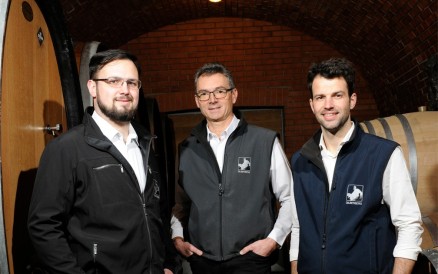
In the 1st Republic (1918-1938), economically distressed farms were taken over by the province of Styria and continued to be run as provincial estates. Silberberg is divided into the Fruit and Wine School and the Provincial Winery. One of the inspection offices for the state inspection number is also located at Silberberg. The five Styrian provincial estates Silberberg, Kitzeck, Schlossberg, Remschnigg and Glanz were united in 1985 to form the "Steiermärkische Landesweingut Silberberg" and a new white wine cellar was also built. Oenologist Ing. Reinhold Holler, cellar master Klaus Fischer and master vintner Johann Schwarz are responsible for the operation. The picture shows the area of the technical school Silberberg with all the outbuildings such as the school, boarding school, winery and workshops. Above them are the Glaser and Steinbruch vineyards.

Vineyards
The vineyards cover around 26 hectares, 90% of which are planted with the white wine varieties Welschriesling, Sauvignon Blanc, Pinot Blanc, Chardonnay (Morillon), Muscat, Pinot Gris, Riesling, Rivaner (Müller-Thurgau), Muscaris and Souvignier Gris, and 10% with the red wine varieties Zweigelt and Cabernet Jura. The vineyards are cultivated in a near-natural way without the use of herbicides. In the Meletin vineyard in Leutschach an der Weinstraße, organic viticulture is carried out according to the rules of ECOVIN and annual controls by Austria Bio Garantie. Here, organic red and white wines grow on Opok soils. A special feature of Großlage Sausal are ten hectares of small terraces, which are cultivated using a specially developed steep slope cultivation model. Artificial irrigation systems (drip irrigation) have been installed on some of the terraces to support the young plants.
Product range
Only grapes from the estate's own vineyards are pressed. The product range is divided into three lines. The "classic wines" are matured in stainless steel tanks without the use of wood. For strong wines such as Sauvignon Blanc and Pinot Blanc, old wooden barrels are used in the vinification process. The "Lagenweine" from the Sausal around Kitzeck from the Steinbruch (classic in stainless steel tanks), Trebien (large wooden bar rel) and Annaberg (used large wooden barrel) sites are vinified separately. The line "B.o.S." = BEST OF Silberberg (barrique) is only produced in special years.
The red wines are matured in the red wine cellar in 300-litre barriques or large wooden barrels. Bottle-fermented sparkling wines, frizzante (sparkling wines), chestnuts (chestnuts), fruit juices, vinegar, oil, verjus and, at the Remschnigg estate, noble brandies (marc, wine, fruit, rowan, medlar, nut, etc.) are also produced and marketed in the estate's own shop. In 1995, a 1.5-kilometre-long educational wine trail was built through the school vineyard. Guided tours and commented tastings for groups, hikes along the wine trail through the school vineyards and seminars in cooperation with the Wine Academy Austria are offered. From 2020, the management of the Episcopal Wine Cellar Seggau was taken over.